Blending two families into one household brings real logistics: two sets of house rules, kids adjusting to a new adult in the home, and co-parenting relationships that don't always cooperate. Family therapy for blended families in San Ramon works best when the therapist has actually handled this specific mix of dynamics, not just general family counseling.
- Sycamore Grove Counseling offers family therapy for blended families in San Ramon and Walnut Creek built around stepfamily-specific dynamics, not generic parenting advice.
- Prioritize a therapist who names loyalty binds and role confusion directly — vague reassurance is a warning sign in 2026.
- Couple's foundation work often needs to happen before whole-family sessions succeed; skipping it is a common misstep.
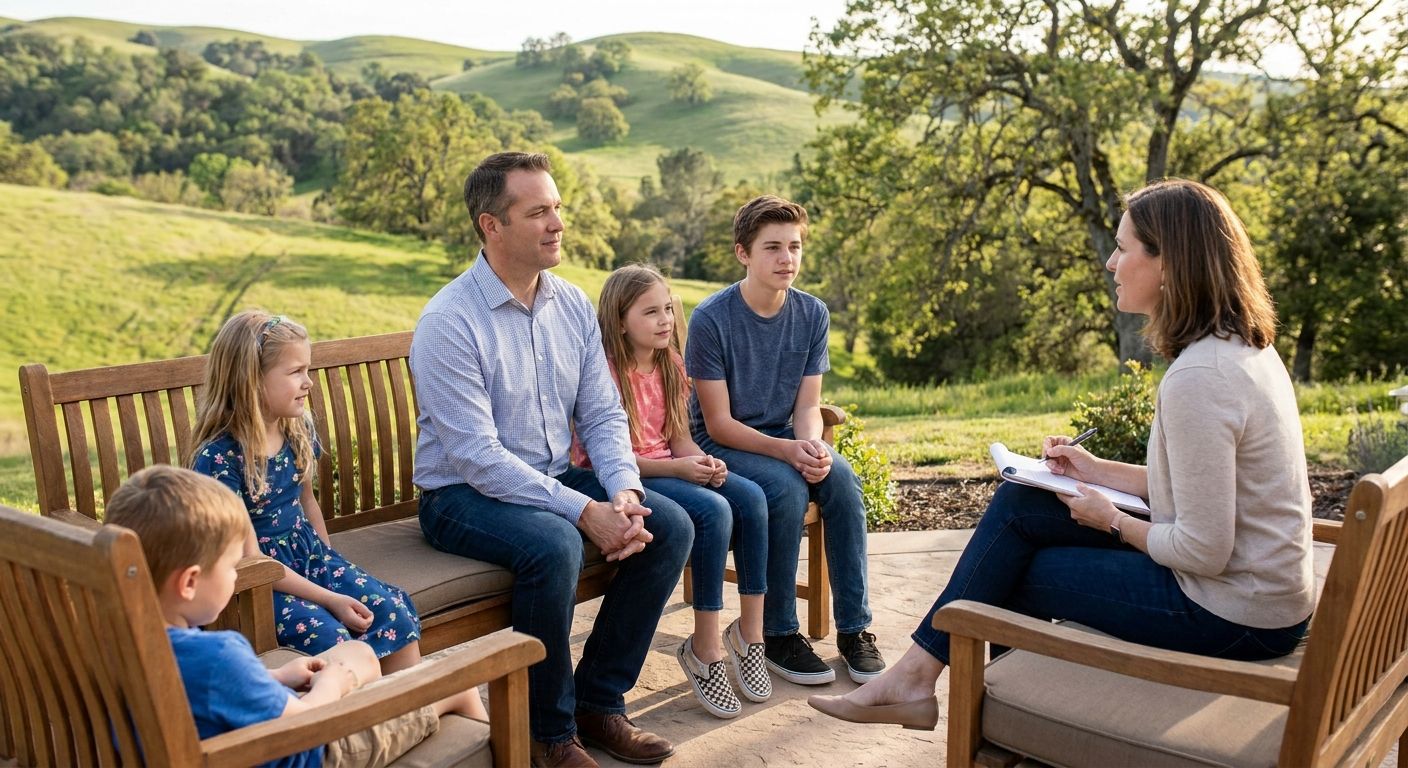
- Whole-family sessions, sub-group sessions, and individual teen support each serve a different purpose — look for a practice offering all three.
Why this matters
A blended family isn't a smaller version of a biological family with an extra adult added in — the emotional wiring is different. Kids carry loyalty to an absent or co-parenting parent even while building a relationship with a stepparent, and that tension shows up as withdrawal, testing behavior, or open conflict long before anyone names what's actually happening.
Generic family therapy sometimes treats these households like any other, focusing on communication scripts without addressing the loyalty bind underneath. Family therapy for blended families in San Ramon works when it starts from the stepfamily structure itself — who has authority, whose rules apply where, and how grief for the old family unit gets space to exist alongside hope for the new one.
Who this is for
This guide is for parents and stepparents in San Ramon or Walnut Creek navigating a household that formed through remarriage, cohabitation, or a new long-term partnership involving kids from a previous relationship. It's also for co-parents managing therapy decisions across two households, and for teens or younger kids showing signs of stress — grades slipping, withdrawal, sudden anger — tied to the family transition rather than an unrelated cause.
What to look for in family therapy for blended families
Experience specific to stepfamily dynamics
A therapist who has worked with dozens of biological-family cases isn't automatically equipped for blended-family work. Ask directly whether the practice has handled stepparent-stepchild relationship building, sibling blending, and co-parenting boundary conflicts — these are distinct skill sets, not a subset of general family counseling.
A framework for loyalty binds and role confusion
Kids in blended households often feel that accepting a stepparent means betraying a biological parent. A therapist who can name this pattern out loud, early, saves months of confused conflict. If the first few sessions don't touch on loyalty at all, that's a gap worth asking about.
Faith-integrated options, when that matters to your family
For families who want their values and beliefs woven into the therapeutic process rather than set aside, faith-integrated therapy changes how sessions get framed — forgiveness, grace, and covenant language show up alongside clinical tools. Not every household wants this, but for those who do, it should be an explicit option, not an afterthought.
Flexible session structure
Blended families rarely resolve everything in one room. Some weeks call for the whole household together; other weeks call for just the couple, or just a struggling teen one-on-one. A practice offering all three structures under one roof means less handoff and more continuity.
Clear boundaries around co-parenting across two households
When kids split time between two homes, therapy has to account for rules and expectations that don't match on both sides. Look for a therapist willing to talk through how sessions handle information from an ex-spouse's household without taking sides.
Local access in San Ramon or Walnut Creek
Consistency matters more than convenience sounds — a family that has to drive 45 minutes each way tends to skip sessions during the exact weeks the extra support is needed most. In-person options in San Ramon and Walnut Creek keep the commitment realistic.
Where blended families in San Ramon start
The couple's foundation — the safe first move. Before whole-family sessions gain traction, the adult partnership usually needs its own footing. A stable couple relationship is the load-bearing wall of a blended household; without it, kids sense instability even when no one says a word. Faith-integrated couples counseling in San Ramon is built for couples who want that foundation work grounded in shared values. Verdict: Strong Fit for couples starting the blending process or hitting friction over parenting authority.
Stepparent-stepchild relationship building — the slow burn. This work rarely resolves in one or two sessions; it's closer to a season of small trust-building steps than a single breakthrough conversation. The goal isn't instant affection, it's reducing daily friction enough that connection has room to grow on its own timeline. Verdict: Consider if a stepparent feels like a roommate rather than a parent figure after six months or more in the home.
Whole-family sessions for sibling blending — the group work. When step-siblings or half-siblings are adjusting to sharing space, rules, and parental attention, sessions with everyone in the room surface comparisons and resentments that never come up in one-on-one conversations. Verdict: Consider for households where sibling conflict has become a daily pattern rather than occasional squabbling.
Individual teen support alongside family work — the side track. Teens often need a space that isn't shared with parents or stepparents to process grief over the family that used to exist, separate from the pressure to perform adjustment for everyone else's benefit. Verdict: Consider when a teen has gone quiet at home but the shift didn't show up anywhere else — school, friendships, activities.
What to avoid
- A therapist who treats the blended household like a standard nuclear family. If loyalty binds, role confusion, and cross-household rules never come up, the framework doesn't fit the situation.
- Skipping couple's work to jump straight to family sessions. Whole-family sessions built on an unstable couple foundation tend to stall or backslide within a few weeks.
- One-size-fits-all co-parenting scripts that ignore the biological parent in the other household. Advice that assumes full control over both homes sets families up to fail the moment it meets reality.
Verdict comparison
| Criteria | Why it matters for blended families | What to confirm before booking |
|---|---|---|
| Stepfamily-specific experience | Generic family therapy misses loyalty binds and role conflict | Ask how many blended-family cases the therapist has handled |
| Loyalty bind framework | Kids need permission to bond with a stepparent without betraying a biological parent | Confirm this comes up in early sessions, not months in |
| Faith-integrated option | Values-aligned language changes how forgiveness and grace get framed | Ask if faith integration is available and optional |
| Session flexibility | Different weeks need different configurations of family members | Confirm whole-family, sub-group, and individual sessions are all offered |
| Co-parenting boundary clarity | Rules and expectations rarely match across two households | Ask how the therapist handles information from the other household |
Start family therapy in San Ramon
Sycamore Grove Counseling offers blended-family and couples sessions in San Ramon and Walnut Creek.
FAQ
What is the best family therapy for blended families in San Ramon?
The best fit is a therapist experienced specifically with stepfamily dynamics — loyalty binds, role confusion, and cross-household co-parenting — rather than general family counseling. Sycamore Grove Counseling offers this work in San Ramon and Walnut Creek, including faith-integrated options for families who want that framing.
How long does blended family therapy usually take?
There's no fixed timeline — stepparent-stepchild relationship building especially tends to unfold over a season rather than a few sessions. Progress usually shows up as reduced daily friction before it shows up as deeper connection.
Should the couple do therapy before the whole family starts sessions?
In most blended households, yes — a stable couple foundation supports everything that follows. Faith-integrated couples counseling is one option for building that foundation before whole-family work begins.
Is faith-integrated therapy better than standard family therapy for blended families?
Neither is inherently better — it depends on whether the family wants values and beliefs woven directly into the therapeutic process. Faith-integrated therapy adds language around forgiveness and grace on top of standard clinical tools.
Do teens need separate sessions from the rest of the blended family?
Often, yes. Teens frequently need space to process grief over the previous family structure without the pressure of performing adjustment in front of parents or stepparents.
How much does family therapy cost in San Ramon in 2026?
Cost varies by practice and session type, so check current rates directly with the provider. Session structure — whole-family, couple, or individual — also affects total sessions needed.
What are signs a blended family needs therapy now?
Watch for a teen or child withdrawing, sudden anger, grades slipping without another explanation, or a stepparent-stepchild relationship that still feels distant after six months or more. These patterns tend to worsen without direct attention.
Can co-parents from two different households join the same therapy process?
This depends on the family's situation and the therapist's approach to information from an outside household. Ask directly how boundaries and confidentiality are handled before starting.
One last thing
The families who make the fastest progress in 2026 aren't the ones with the least conflict — they're the ones who stop expecting the blended household to function like the family that came before it. Family therapy for blended families in San Ramon works when everyone in the room, including the adults, accepts that this is a new structure with its own rules, not a repaired version of an old one.