Choosing a therapist who treats your faith as an asset, not an obstacle, changes what couples work happens in the room. This guide breaks down what to look for in faith-integrated couples therapy in San Ramon and where Sycamore Grove Counseling fits into that decision.
- Sycamore Grove Counseling offers faith-integrated couples therapy in San Ramon and Walnut Creek, CA — a fit for couples who want scripture and values woven into sessions, not sidelined.
- Emotionally Focused Therapy (EFT) research shows 70-75% of couples move from distress to recovery, making it a strong evidence base to pair with faith integration.
- A 50-60 minute weekly session is the industry standard for couples work in 2026 — anything shorter rarely covers both partners' concerns.
- Skip a purely secular generalist if faith is central to your marriage; skip a pastor-only counselor if there are entrenched conflict patterns needing clinical training.
- Book a consultation before committing to a full course of sessions so you can gauge fit on faith language and clinical approach together.
Why this matters
Couples in San Ramon looking for faith-based support often hit one of two walls: a secular therapist who treats their faith as background noise, or a pastoral counselor with no clinical training in conflict cycles, attachment injuries, or trauma. Neither gap serves a marriage under real strain.
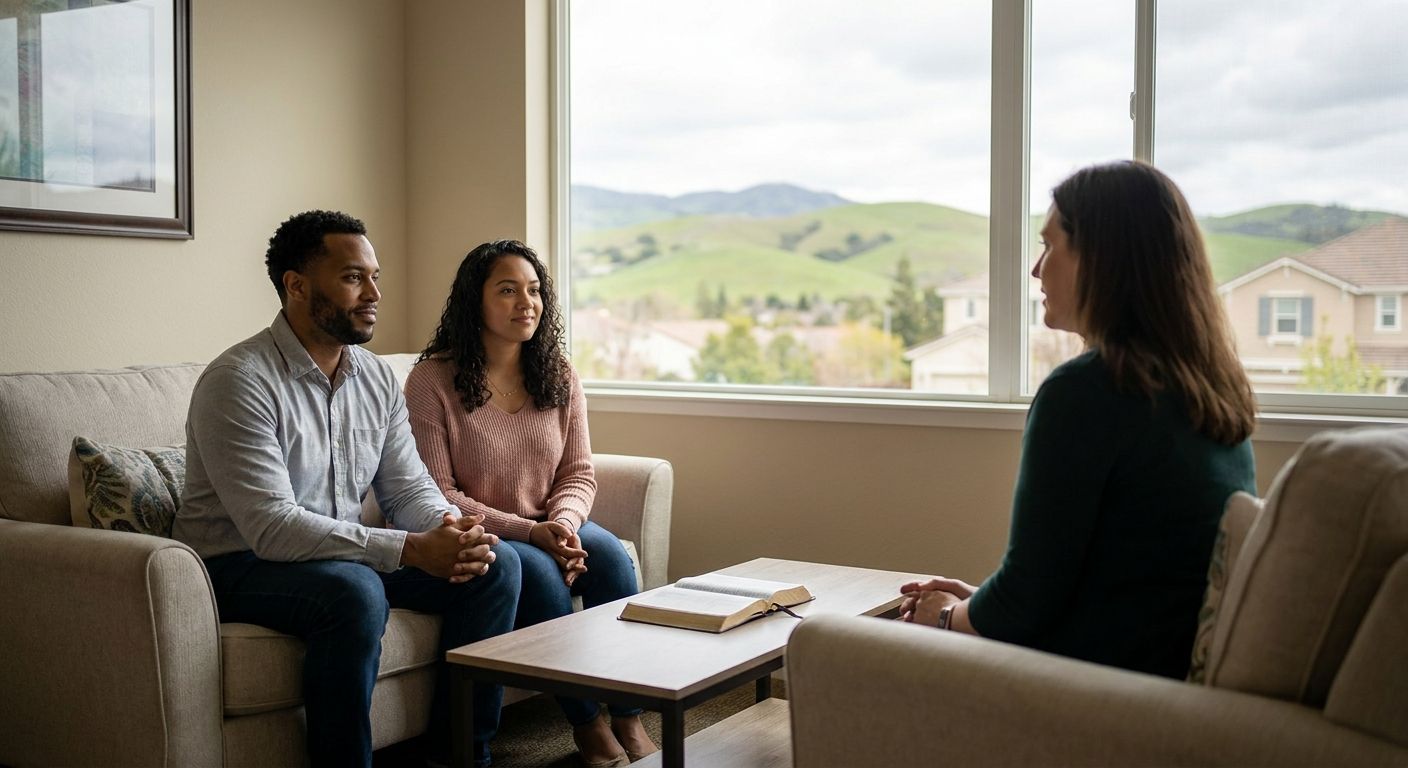
Faith-integrated couples therapy closes that gap by combining licensed clinical methods with explicit space for prayer, scripture, or values-based framing when a couple wants it. Sycamore Grove Counseling works from San Ramon and Walnut Creek, CA, offering this blend alongside individual, family, and teen therapy. The rest of this guide tells you what to check before booking anyone, including them.
Who this is for
This guide is for couples in San Ramon and the surrounding Tri-Valley who want their marriage counseling to reflect their faith commitments, not work around them. That includes engaged couples doing premarital preparation, married couples navigating a specific rupture (infidelity, resentment, a major life transition), and long-married partners who feel disconnected but don't want a therapist who dismisses the role their faith plays in how they define commitment, forgiveness, or conflict repair.
If you and your partner already agree that faith should be part of the conversation — not the whole conversation, but part of it — the criteria below will help you vet who's actually equipped to do that well.
What to look for in faith-integrated couples therapy
Clinical licensure, not just pastoral training
A counselor who can speak your faith language but lacks a clinical license (LMFT, LCSW, LPCC in California) can't diagnose or treat the deeper patterns — attachment wounds, trauma responses, chronic conflict cycles — that often sit underneath "we just don't connect anymore." Faith integration should sit on top of clinical training, not replace it.
An evidence-based couples model
Ask what framework the therapist actually uses. Gottman Method and Emotionally Focused Therapy are the two most researched couples modalities as of 2026, and both can be adapted to include faith language without losing their clinical structure. A therapist who can't name their model is likely improvising.
Comfort naming faith explicitly, not just avoiding offense
There's a difference between a therapist who won't criticize your faith and one who can actively use scripture, prayer, or theological language as a therapeutic tool when you ask for it. The second is what "faith-integrated" actually means — the first is just neutral.
Session length and format that fits two schedules
A 50-60 minute weekly session is standard for couples work in 2026. Confirm whether sessions run in-person in San Ramon or Walnut Creek, or by telehealth, since format mismatches are one of the most common reasons couples drop out of therapy in the first month.
Willingness to work with both partners' comfort levels
It's common for one partner to want heavy faith integration and the other to want a lighter touch. A therapist who can flex between the two without forcing either partner's comfort level onto the other is doing the job correctly.
A clear intake process before you commit
A short consultation call or intake session should tell you whether the clinical approach and the faith language actually match what you're looking for, before you sign up for a longer course of sessions.
Which approach fits your relationship
Faith-integrated Emotionally Focused Therapy — the evidence-heavy pick. EFT is built around identifying the negative cycle a couple gets stuck in and replacing it with secure emotional responses. Research on EFT (Johnson, Hunsley, Greenberg & Schindler, 1999) shows roughly 70-75% of couples move from distress to recovery, one of the stronger outcome numbers in couples research. When a therapist layers scripture on attachment language — using the language of covenant alongside the language of secure bonding — it gives couples a framework that's both clinically grounded and faith-consistent. Consider this first if you want research backing behind the faith integration.
Faith-integrated Gottman Method — the structured pick. Gottman Method relies on decades of observational research into what predicts divorce and what predicts repair, including concepts like the "four horsemen" of criticism, contempt, defensiveness, and stonewalling. A faith-integrated version pairs those clinical markers with values-based repair language, which works well for couples who like clear frameworks and homework between sessions. Consider this if you and your partner respond well to structure and concrete exercises.
Premarital and pastoral-blend counseling — the preventive pick. For engaged couples, premarital counseling that blends clinical assessment with faith-based conversations about roles, finances, and conflict style catches issues before the wedding, not after. This works best when the counselor is licensed and doing more than a values questionnaire. Buy in if you're engaged and want more than a single pre-wedding session.
A purely secular couples therapist who "doesn't mind" faith talk — the compromise pick, and usually the wrong one. Tolerance isn't integration. If a therapist will let you mention your faith but won't use it as a working tool in sessions, you're getting generic couples therapy with a faith-neutral label. Skip this if faith integration is the actual reason you're looking for a therapist.
What to avoid
- A pastor or lay counselor with no clinical license handling entrenched conflict. Faith conversations alone rarely resolve attachment injuries or trauma-driven conflict cycles — that needs licensed clinical training underneath the faith framing.
- A therapist who treats "faith-integrated" as a marketing label without a defined method. If they can't describe how faith actually shows up in a session — through prayer, scripture discussion, or values framing — the label is doing more work than the practice.
- Individual-only sessions for a couples problem. One partner going alone to "work on themselves" rarely shifts a relational pattern that both partners are reinforcing. Couples issues generally need both people in the room, even if individual sessions run alongside it.
Talk to a faith-integrated couples therapist
Sycamore Grove Counseling serves couples in San Ramon and Walnut Creek, CA.
Verdict comparison
| Approach | Best for | Faith integration depth | Verdict |
|---|---|---|---|
| Faith-integrated EFT | Emotional disconnection, recurring conflict cycles | High — scripture paired with attachment language | Consider first |
| Faith-integrated Gottman Method | Couples who like structure and homework | Moderate to high | Consider |
| Premarital/pastoral blend | Engaged couples preparing for marriage | High | Buy in |
| Secular-only with faith tolerance | Couples who don't need faith in the room | Low | Skip if faith matters to you |
FAQ
What is faith-based couples therapy?
Faith-based couples therapy combines licensed clinical methods, like EFT or Gottman Method, with explicit faith elements such as scripture, prayer, or values-based framing. It differs from secular therapy in that faith isn't set aside — it's used as part of the working relationship.
Is faith-integrated therapy only for Christian couples?
Most faith-integrated practices in the San Ramon area focus on Christian frameworks, but the core principle — treating a couple's faith as relevant to their conflict and repair patterns — applies across traditions. Confirm with the specific practice which faith background they work within.
How is faith-based couples therapy different from pastoral counseling?
Pastoral counseling is typically led by clergy without a clinical license and focuses on spiritual guidance. Faith-integrated therapy is led by a licensed clinician (LMFT, LCSW, or LPCC in California) who adds faith language on top of clinical treatment for conflict, trauma, or attachment issues.
How long does couples therapy usually take?
Sessions typically run 50-60 minutes weekly, and the total course varies by the issue being addressed — a few months for a specific conflict, longer for deeper patterns like infidelity recovery. Consistency in scheduling matters more than any fixed number of sessions.
Does Sycamore Grove Counseling offer faith-integrated therapy in San Ramon?
Yes, Sycamore Grove Counseling offers faith-integrated therapy for couples, along with individual, family, and teen therapy, from San Ramon and Walnut Creek, CA locations.
Can only one partner attend faith-integrated couples therapy?
Couples therapy generally works best with both partners present, since the goal is to shift a shared pattern rather than one person's individual behavior. Some practices offer individual sessions alongside joint sessions when needed.
What questions should I ask before booking a couples therapist?
Ask what clinical model they use, how faith actually shows up in session, whether they're licensed in California, and what session format and length they offer. A short consultation call should answer all four before you commit to a full course.
Is premarital counseling worth it before marriage?
Premarital counseling gives engaged couples a structured space to address finances, roles, and conflict style before the pressures of married life set in. Look for a licensed counselor rather than a single pre-wedding conversation with clergy alone.
One last thing
The single biggest predictor of whether faith-integrated couples therapy actually works isn't the therapist's credentials — it's whether both partners agree, before the first session, on how much faith language they want in the room. Couples who skip that conversation and let it surface mid-session waste weeks re-negotiating format instead of doing the actual relationship work. Settle that one question with your partner in 2026 before you book anything, faith-integrated or not.